
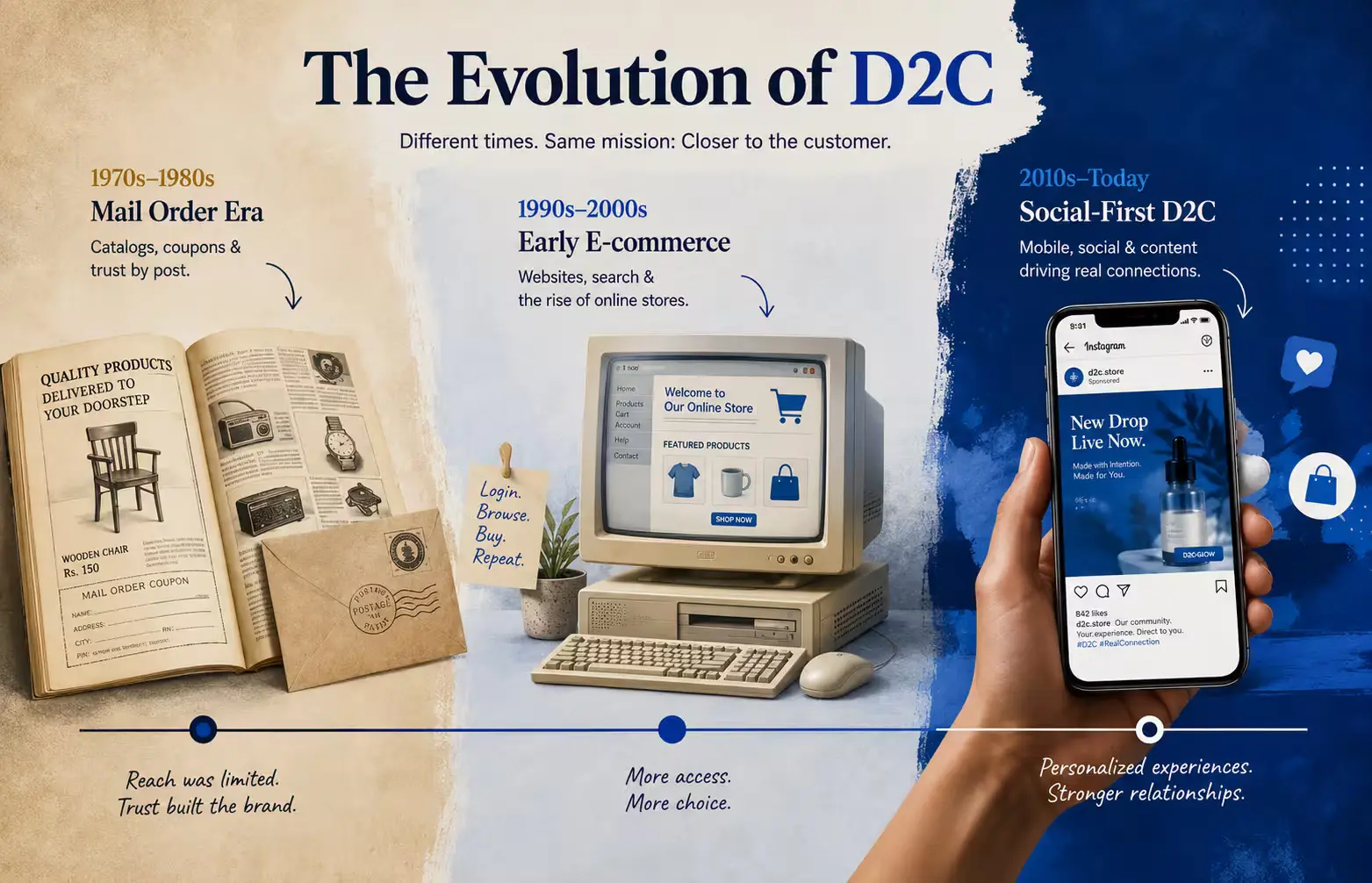
The Complete History & Evolution of D2C - Including India's D2C Boom
If you search "history of D2C" right now, you'll mostly find the same five paragraphs recycled: Warby Parker, Casper, Dollar Shave Club, a line about Instagram ads, done. It talks about why D2C exists - cutting out the middleman - but never explains who actually built the model, and it completely ignores India, now one of the largest D2C markets in the world.
This guide fills that gap. Here's where D2C actually came from, how it evolved into the model we know today, and how India turned it into a ₹6.6-lakh-crore-plus industry with homegrown brands like Mamaearth, boAt, Sugar Cosmetics, and Wow Skin Science.
What Does D2C Actually Mean?
Direct-to-consumer (D2C or DTC) is a business model where a brand sells its own products straight to the end customer - no distributor, no wholesaler, no retail shelf in between. The brand owns the website, the pricing, the customer data, and the entire relationship from first click to repeat purchase.
That's the modern definition. But the idea behind it - sell directly, skip the middleman - is far older than Instagram ads and influencer unboxings.
The Real History of D2C: It Didn't Start on the Internet
1886–1903: The Original D2C Brands
Long before "D2C" was a term anyone used, companies were already doing it:
- Avon (1886) built a direct sales network of door-to-door representatives, skipping retail entirely and relying on personal relationships to sell.
- Gillette (1903) sold its new safety razor directly to consumers through mail-order catalogs, a genuinely disruptive move for the era.
These aren't footnotes - they're the actual origin of the model. The mechanics were different (catalogs and sales reps instead of websites), but the core bet was identical to what today's D2C founders are still making: cut out the middleman, own the customer relationship.
1990s: Dell and the First Digital Disruption
Dell's decision to sell computers directly to consumers online in the 1990s, bypassing retail stores entirely, was arguably the first true digital D2C business. It proved that an entire category - not just razors or cosmetics - could be sold this way at scale.
2010–2016: The Silicon Valley D2C Wave
This is the era most "history of D2C" articles start from - and stop at. Cheap Shopify storefronts, Facebook ad targeting, and venture capital combined to produce a wave of digitally-native brands: Warby Parker, Casper, Dollar Shave Club, Away, Everlane, and Glossier. They shared a playbook - borrowed supply chains, direct distribution, and social-first marketing - and for a few years, the model looked unstoppable.

2019–2022: The Reality Check
By the early 2020s, rising ad costs (especially after Apple's iOS privacy changes hit Facebook targeting) exposed a weakness in the pure-D2C playbook: customer acquisition costs that once looked cheap got expensive fast, and several early poster-children struggled or were acquired. The lesson the industry learned wasn't that D2C failed — it was that D2C without retail, retention, and real unit economics doesn't survive.
India's D2C Boom: The Part of the Story Everyone Skips
While the West was recalibrating, India's D2C market was just getting started - and it grew on a very different foundation: mobile-first internet access, UPI payments, and a generation of Gen Z and millennial shoppers who trusted Instagram and YouTube over traditional advertising.
India's D2C sector is now valued in the multiple lakh-crore range, with projections putting it on a path toward roughly $100 billion by 2030, and hundreds of active D2C brands competing for share.
Here are the brands that actually built India's version of this story:
Mamaearth (2016) - Founded by Ghazal and Varun Alagh after struggling to find toxin-free baby products, Mamaearth grew into one of India's first D2C unicorns and eventually went public, built almost entirely on a clean-beauty, parent-to-parent trust narrative.
boAt - Started as a small audio accessories brand and grew into India's largest homegrown audio and wearables company, powered by youth-focused branding and aggressive influencer marketing rather than legacy retail distribution.
Sugar Cosmetics (2012/2015) - Built around makeup shades designed for Indian skin tones, Sugar scaled through digital-first marketing before deliberately expanding into tens of thousands of offline outlets - proving D2C and retail aren't opposites in India, they're sequential.
Wow Skin Science - A natural skincare brand that scaled to hundreds of crores in revenue by leaning into ingredient transparency and India's growing "clean beauty" search demand.
Wakefit, Licious, Plum, Lenskart - Each took the same core idea - mattresses, meat, vegan beauty, eyewear - and rebuilt distribution around direct online sales, data ownership, and (eventually) hybrid offline expansion.

Why the D2C Model Exploded Specifically in India
A few forces converged that didn't exist in the West's first D2C wave:
- Cheap mobile data made scrolling, watching, and buying on a phone the default shopping behavior for hundreds of millions of new internet users.
- UPI and digital payments removed the friction of cash-on-delivery-only commerce.
- Distrust of "legacy" categories - younger Indian consumers, especially Gen Z, associate older FMCG brands with their parents' generation, creating an opening for newer, digitally-native names.
- Tier-2 and Tier-3 reach - D2C brands could reach smaller-city consumers instantly online, something legacy retail distribution took decades to achieve.

What This Means If You're Building or Marketing a D2C Brand Today
The biggest misconception left over from the first D2C wave is that this model is purely a marketing tactic - run some ads, skip the retailer, done. India's most durable D2C brands (Sugar Cosmetics expanding into 40,000+ offline outlets, Mamaearth building a public-company balance sheet) show the opposite: D2C is a starting distribution strategy, not a permanent constraint. The brands that last treat content, retention, and eventually omnichannel expansion as part of the same growth engine - not a plan B.
That's also where content and SEO come in. Unlike paid ads, which stop producing the moment you stop paying, a well-built content and search presence keeps working long after it's published - which is exactly why D2C brands with strong organic content tend to have lower long-term acquisition costs than those relying purely on performance marketing.
Frequently Asked Questions
D2C (direct-to-consumer) means a brand sells its products straight to customers through its own website or channels, without going through a retailer, wholesaler, or distributor.
While the term "D2C" is recent, the model dates back to Avon's door-to-door sales network in 1886 and Gillette's mail-order razor sales in 1903 - both sold directly to consumers without retail middlemen.
D2C is technically a type of B2C (business-to-consumer), but it specifically refers to brands that manufacture their own product and sell it directly, without any third-party retailer involved.
They combined a genuinely differentiated product with direct online distribution and heavy social-media-driven marketing, cutting both cost and friction out of traditionally slow-moving categories like eyewear and mattresses.
Rising digital ad costs and privacy changes (like Apple's iOS tracking restrictions) made customer acquisition through paid social far more expensive, exposing brands that hadn't built retention or diversified channels.
India's D2C boom was built on mobile-first internet access, UPI digital payments, and a younger consumer base actively distrusting "legacy" brands - factors that didn't shape the original Western D2C wave.
Mamaearth, boAt, Sugar Cosmetics, Wow Skin Science, Wakefit, Licious, Plum, and Lenskart are among the most recognized homegrown D2C brands in India today.
India's D2C sector has been valued in the multiple lakh-crore range, with projections pointing toward continued rapid growth this decade as internet penetration and e-commerce adoption keep rising.
Yes - many of India's most successful D2C brands, including Sugar Cosmetics, deliberately expanded into physical retail after building their digital-first customer base, showing D2C and offline retail aren't mutually exclusive.
Not exactly. E-commerce is the channel (selling online); D2C is the business model (selling your own products directly to consumers, which usually happens via e-commerce, but doesn't have to).
The next phase is less about ad-driven acquisition and more about retention, first-party data, omnichannel presence, and organic content/SEO - channels that keep working without continuous ad spend.