
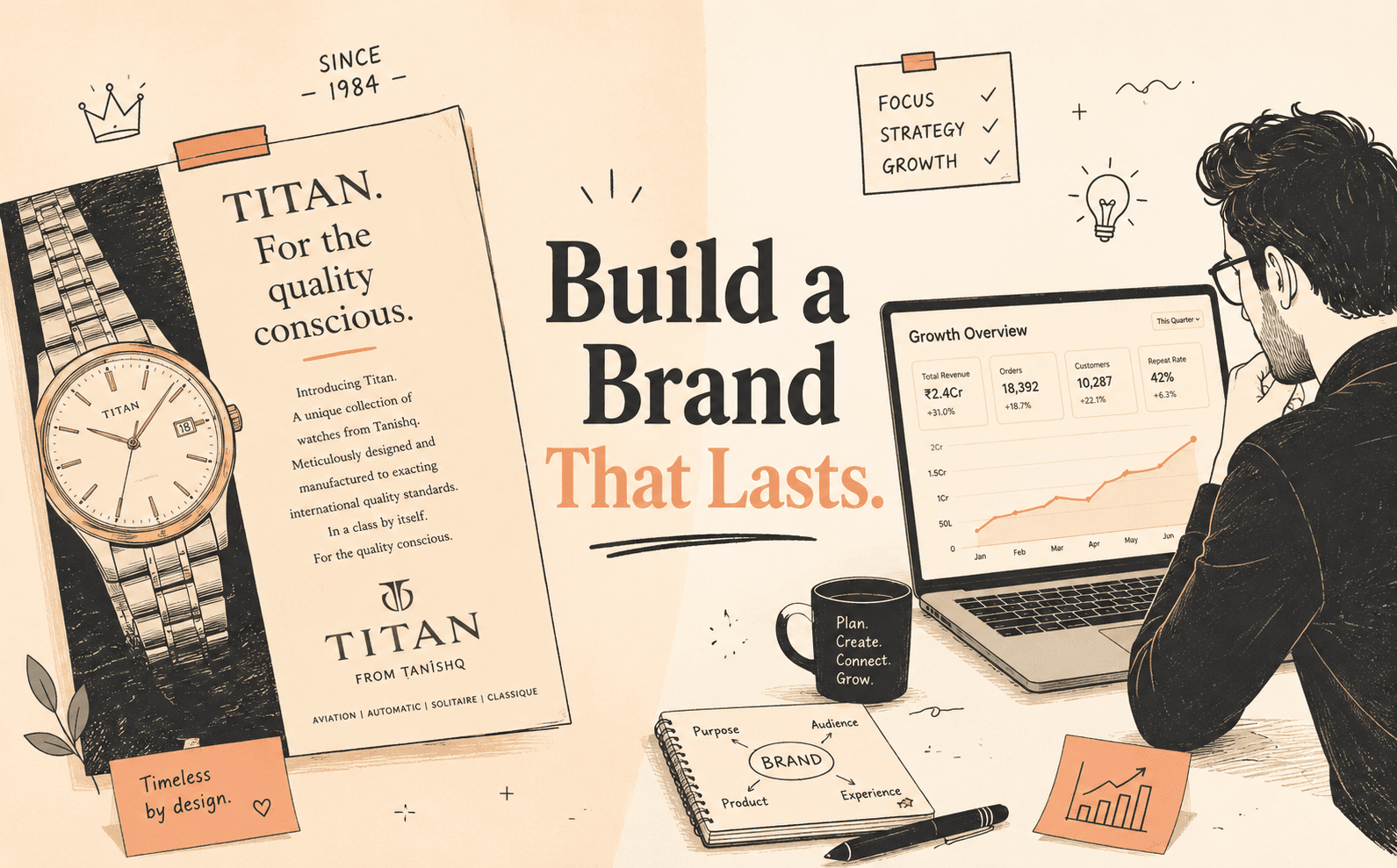
How Titan Built One of India's Strongest Brands:7 Marketing Lessons for Modern D2C Businesses
If you have watched Made in India: A Titan Story, you already know it is more than a binge-worthy series. It is a four-decade masterclass in brand building, customer acquisition, and market positioning - played out in real time before India even had the internet.
Most people finish it feeling inspired and move on. Founders should not do that.
Titan's journey carries lessons that are directly applicable to every D2C brand trying to grow in 2026. At d2cora, we work with founders on exactly these challenges - positioning, awareness, acquisition, and sustainable growth. Here is what Titan's story teaches us.
Lesson 1: Nail Your Brand Positioning Before You Spend a Rupee on Ads
In a market controlled by smuggled Swiss imports and government-made HMT watches, Titan did not compete on price. They created a third category entirely - aspirational, Indian-made, and available in a proper branded showroom. That is brand positioning strategy done right.
A clear brand positioning statement answers one question: why would your ideal customer choose you over everything else? Not because you are cheaper. Not because you have more features. Because of what your brand represents to them.
For D2C brands today, this is where the foundation is laid. Every ad campaign, every content marketing piece, every influencer partnership - all of it either reinforces your positioning or dilutes it. Get this wrong and no amount of ad spend will save you.
Lesson 2: Build Awareness Before You Scale - Not After
One of the most consistent mistakes early D2C brands make is pouring budget into performance marketing before the brand means anything to anyone. ROAS dips, they spend more, it dips further. The problem is not the ads - it is that nobody recognises the brand behind the ad.
Titan built familiarity before they asked for the sale. The Mozart symphony in their Doordarshan ads made Titan feel like something you already knew and trusted, before you had ever walked into a showroom. That is brand awareness strategy working exactly as it should.
The modern equivalent is content marketing and consistent social media marketing - both building recognition before you ask for a click. When customers already recognise your brand, every paid campaign becomes significantly more efficient.
Lesson 3: Own Your Customer Acquisition - Don't Just Rent It

Titan's most powerful customer acquisition move was deceptively simple: control the first touchpoint. Instead of relying on multi-brand distributors, they built Titan World - their own showroom network. They owned the environment where customers first encountered the brand.
Today, D2C brands have the same opportunity at a fraction of the cost. But too many build their entire acquisition strategy on rented channels - Meta ads, Google ads, marketplace listings. The moment the algorithm changes or cost-per-click spikes, growth stops.
Owned channels - email lists, SEO traffic, WhatsApp communities, referral programmes - compound in value over time. Performance marketing should amplify what you own, not replace it. According to HBR, brands that invest in owned relationships consistently outperform those that rely solely on paid acquisition over a 5-year horizon.
Lesson 4: Find the One Thing You Do Better Than Anyone Else
When Swiss watchmakers shut Titan out of global collaborations - a deliberate move to block Indian manufacturers from competing - Titan responded by building the Titan Edge: the world's slimmest watch at the time.
They did not try to copy Swiss craftsmanship. They leapfrogged it. And in doing so, flipped their entire positioning. They were no longer 'a good Indian watch.' They became 'the brand that made something no Swiss manufacturer had ever achieved.'
For D2C brands, the question is identical: what does your product do meaningfully better than everything else in your category? Not slightly better. Meaningfully better. Find that difference, and build every content piece and campaign around proving it. Visit Titan's official site to see how they still lead with innovation as their core brand message.
Lesson 5: Your Website Is Your Showroom - Treat It Like One

Titan World showrooms were not just places to buy watches. They were branded environments - the lighting, the layout, the staff training, the display cases - every element reinforced the brand's identity. The product was different, but the environment made the difference feel larger.
Your ecommerce website needs to do the same job. A cluttered product page with generic photography and weak copy does not just fail to convert - it actively undermines the brand you are trying to build.
Look at every page on your store as a brand-building investment. If your content marketing strategy is pulling in the right traffic, the website needs to be good enough to convert it and retain it. Shopify's own research consistently shows that brands with strong on-site content and clear positioning outperform those relying solely on paid acquisition.
Lesson 6: Consistency Is the Most Underrated Marketing Strategy
The Mozart symphony in Titan's ads ran for years. Same music. Same emotional register. Same feeling of quiet, understated elegance. This was not a lack of creativity - it was discipline.
Brand personality only creates loyalty when it shows up consistently across every touchpoint, every campaign, every year. The brands with the highest customer lifetime value are almost always the ones with the most consistent personality. Loyalty is not built by features. It is built by feeling.
For modern D2C brands, this applies across your Instagram grid, email copy, packaging, customer service responses, and social media marketing content. Inconsistency across any one of these breaks the trust you have worked hard to build.
Lesson 7: Organic Visibility Is the Modern Distribution Channel
Titan spent heavily on Doordarshan advertising not because it was cheap - it was not - but because they knew that visibility at scale was non-negotiable for brand growth. You cannot build a trusted brand in the dark.
Today, ecommerce SEO is the most cost-effective equivalent of that national visibility. Unlike paid advertising, which stops working the moment you stop spending, SEO compounds. Every optimised product page, every well-written blog post, every earned backlink builds authority that generates traffic and sales 24 hours a day.
For Shopify brands, a serious SEO strategy reduces your blended customer acquisition cost over time and makes every paid campaign more efficient - because organic traffic builds the brand familiarity that paid traffic converts on. Explore our full range of D2C marketing services to see how we approach this end-to-end.
The Real Lesson from Titan: Build a Brand, Not Just a Business

Titan did not become India's most trusted watch brand by outspending competitors. They got there by treating every decision - positioning, awareness, acquisition, innovation, experience, consistency, and visibility - as a brand-building decision, not just a business decision.
That is the distinction most early D2C brands miss. They optimise for sales. Titan optimised for brand. And brand is what makes every subsequent sale easier, cheaper, and more valuable.
These seven lessons are not theory. They are the operational principles behind one of India's greatest commercial success stories, translated into the language of modern D2C marketing and ecommerce growth. Start with your positioning. Build awareness before you scale. Own your acquisition channels. Innovate around your real difference. Treat every digital touchpoint as a brand environment. Stay consistent. And invest in organic visibility like it is a long-term asset - because it is.
Titan proved this works over forty years. The tools available to you in 2026 can help you do it in a fraction of the time. The question is not whether these lessons apply to your brand. The question is which one you are going to act on first.
Frequently Asked Questions
Titan's entrepreneurial journey teaches seven core lessons: nail your brand positioning before scaling ads, build awareness before spending on growth, own your customer acquisition channels rather than renting them, innovate around a genuine difference, treat every customer touchpoint as a brand environment, maintain consistent brand personality, and invest in organic visibility for long-term growth. These principles are as relevant for a D2C startup in 2026 as they were for Titan in 1984.
The primary lesson from studying entrepreneurs like Xerxes Desai - the founder behind Titan - is that the most enduring businesses are built on brand, not just product. Titan did not win because they had a better watch. They won because they created a brand that represented something meaningful to the Indian consumer. The product got customers in the door. The brand kept them coming back.
The seven marketing principles from Titan's story are:
(1) clear brand positioning strategy
(2) brand awareness before scale
(3) owned customer acquisition channels
(4) product innovation as differentiation
(5) treating distribution and digital touchpoints as brand environments
(6) consistent brand personality across every channel
(7) long-term organic visibility through ecommerce SEO and content marketing.
The most important lesson is that brand and business are not separate things. Every operational decision - from pricing to distribution to customer service - is a brand decision. Titan understood this from day one. They did not build a watch company that happened to have good marketing. They built a brand that happened to make watches. That distinction is everything for modern D2C founders.
In 2026, D2C markets are more crowded than ever. Products are easier to copy, advertising costs are rising, and customer attention is fragmented across more channels than before. Brand positioning strategy matters now more than ever because it is the only sustainable competitive advantage that cannot be replicated. A clear positioning statement means customers choose you not just for what you sell, but for what you represent - which improves loyalty, reduces acquisition costs, and compounds brand value over time.
Titan's biggest distribution insight was that owning the customer touchpoint is a marketing strategy, not just a logistics decision. They built Titan World showrooms to control the first impression. For modern ecommerce brands, this translates to investing in your own website and digital channels rather than relying entirely on marketplaces or paid platforms. Your Shopify store, email list, and SEO presence are your owned distribution - and they compound in value the longer you invest in them.
Brand awareness directly reduces customer acquisition costs by improving conversion rates and ad efficiency. When a potential customer already recognises and trusts your brand before seeing your advertisement, they are significantly more likely to click, convert, and return. Titan's years of consistent advertising on Doordarshan meant that by the time a customer walked into a showroom, they already trusted the brand. For D2C brands today, content marketing, organic SEO, and social media presence serve this same awareness-building function.